Showing posts with label Finnish bakery. Show all posts

17 October 2012

Desmontando la enfermería de campaña (näkkileipä)

(English version below)

He hecho una pausa como enfermera a tiempo parcial para traeros una receta finlandesa, que ya tocaba. No sé si es la más fácil que he publicado en el blog, pero os aseguro que se hace en un abrir y cerrar de ojos y un abrir y cerrar de puerta de horno. El näkkileipä es el crispbread finlandés, son tortas o barritas de pan de centeno muy finas, crujientes y con infinidad de posibilidades. Se pueden untar con mantequilla o queso crema, prepararlas como una tosta con salmón ahumado y crème fraîche, queso y tomate, meetvursti y pepinillos... libre albedrío. Nuestra opción más recurrente es con mantequilla y escamas de sal, dadle una oportunidad, es sorprendente.

Hay cientos de recetas de näkkileipä, con más harina de centeno, con menos, con harina integral, con semillas de hinojo, sésamo, comino, más finos, más gruesos... Ésta es la mía, muy finos y con pipas de girasol.

Por cierto, muchas gracias a todos los que os interesasteis por la recuperación de Herra K, gracias por todos los comentarios y el apoyo, sois geniales. Ésta va por vosotros.


Herra K, recuperándose

Näkkileipä


Ingredientes (para 12 unidades):

100 grs de harina de centeno
70 grs de harina de trigo
20 grs de pipas de girasol peladas (sin sal)
1 dl de agua
1 cucharada de mantequilla derretida
Una pizca de sal


Modus operandi:

1. Precalienta el horno a 220 C.

2. Mezcla todos los ingredientes en un bol y amasa con las manos hasta conseguir una bola de masa compacta.

3. Divide la masa en 12 bolas pequeñas. Espolvorea con harina la superficie de trabajo y estira cada bola todo lo que puedas con un rodillo de amasar. No te preocupes por la forma, cuanto más feas, más auténticas parecerán.

4. Coloca los näkkileipä en dos bandejas de horno preparadas con papel vegetal, 6 en cada una.

5. Hornea durante 8 – 10 minutos o hasta que estén dorados.

*Si prefieres hacer los näkkileipä un poco más gruesos, pínchalos con un tenedor antes de hornearlos.

Hyvää ruokahalua!

*****


Today I've had a little break as part-time nurse to bring you a Finnish recipe. Yes, finally. I don't know if this is the easiest recipe I've ever published in the blog, but be sure you can do this in the blink of an eye. The näkkileipä is the Finnish crispbread, a very flat kinda-cracker bread, made from rye flour mostly, crunchy and versatile. You can spread butter or cream cheese on them, or prepare them with smoked salmon and crème fraîche, or cheese and tomatoes, or meetvursti and pickles, or... free will. We usually eat them with butter and salt flakes, give it a try, it's surprisingly good.

There are hundreds of different näkkileipä recipes, with more or less rye flour, with wholewheat flour, with fennel or sesame seeds, with cumin, thinner or thicker... This is my own, very thin and with sunflower seeds.

By the way, thank you very much to all of you who sent all those good wishes for Herra K, thanks for all the comments and the support, you are simply great. This one is for you. 


Näkkileipä


Ingredients (makes 12):

100 g rye flour
70 g plain wheat flour
20 g unsalted shelled sunflower seeds
1 dl water
1 tbsp melted butter
A pinch of salt


Modus operandi:

1. Preheat the oven to 220 C.

2. Mix all the ingredients in a bowl and knead with your hands until you get a solid ball dough.

3. Divide the dough in 12 small balls. Dust your working surface with some flour and roll each ball out until very thin, using a rolling pin. Don't worry about the shape; the ugliest will be the most genuine.

4. Place the näkkileipä in two baking trays prepared with baking paper (6 in each one).

5. Bake for 8 – 10 minutes or until golden brown.

*If you prefer to make thicker näkkileipä, poke holes with a fork all over the surface of each näkkileipä before baking.

Hyvää ruokahalua!


28 June 2012

Hyvää Juhannusta! Parte 2 (Stefanin raparperipiirakka)


(English version below)

Lo prometido es deuda así que aquí os traigo el desenlace de la “noche” de San Juan. Como os comenté en la primera parte, el plan era ir primero al centro de Helsinki a vivir en nuestras carnes el “apocalipsis zombie” y después irnos a ver las hogueras a Seurasaari, una de las elecciones más populares para los que se quedan en la ciudad.

El apocalipsis fue digno de ver, cierto es que las 3 ó 4 calles más céntricas estaban llenas de turistas disfrutando del solecito, pero el resto de la ciudad era un desierto. Helsinki fantasma. Daba gusto darse una vuelta con ese calorcito y ese silencio... no se oían ni moscas.


Me costaba trabajo creer que todo el mundo se había largado de la ciudad el fin de semana y llevaba razón. La mitad estaría en la cabañita en plan bucólico campestre pero la otra mitad estaba... esperando el autobús 24 para ir a Seurasaari. Desde el último metro que cogí en Madrid no me había vuelto a sentir tan sardina en una lata.

Así que allí nos plantamos, unos cuantos cientos de fineses, Herra K, la cámara y yo. Seurasaari es una isla museo al aire libre que bien merece una entrada aparte así que prometo enseñárosla como mandan los cánones en otra ocasión. Estaba cerrada para el evento, y había un montón de actividades relacionadas con antiguas tradiciones finesas: teatro, bailes típicos, artesanía, juegos tradicionales, exhibiciones de maderada... y hogueras.


Seis hogueras, cada una con su particular ritual según la región de procedencia: Estonia, Ingria, Carelia... y la última, la principal, encendida por una pareja que es elegida para casarse ese día en Seurasaari y que llega en barca hasta los pies de la hoguera, gigantesca.


Como una imagen vale más que mil palabras aquí tenéis unas cuantas. Las últimas son en el camino de vuelta a casa, a medianoche.


Mi segunda promesa era una receta nórdica y aquí está. La tarta de ruibarbo es muy típica en los países nórdicos pero esta es especial. Según Hans Välimäki (chef finlandés del que ya os he hablado alguna vez) es la mejor tarta de ruibarbo del mundo, y no sé si será digna de ese honor, pero es una auténtica delicia. El punto fuerte del ruibarbo con el toque de canela, el relleno suave y esponjoso y el crujiente de la cobertura la han convertido en una de mis favoritas. La receta es de Stefan Karlsson, chef sueco amigo de Välimäki, y la he encontrado aquí, después de que Välimäki se la soplara a toda Finlandia en un programa de televisión mañanero. 


Tarta de ruibarbo de Stefan


Ingredientes:

Para la base:

300 grs de harina de trigo
200 grs de azúcar blanquilla
100 grs de mantequilla
1 huevo
½ cucharadita de sal

Para la primera capa:

Ruibarbo pelado y picado
1 dl de azúcar blanquilla
1 ó 2 cucharadas de canela molida

Para la segunda capa:

2 huevos
4 ó 5 cucharadas de azúcar blanquilla
½ dl de nata 35%
½ dl de leche
1 vaina de vainilla
4 cucharadas de harina de trigo
2 cucharadas de mantequilla derretida

Para terminar:

Azúcar glass
Helado de vainilla

Modus operandi:

1. Mezcla los ingredientes de la base con las manos. Amasa hasta que estén todos bien integrados y deja reposar en el frigorífico durante 1 hora.

2. Mezcla el ruibarbo con el azúcar y la canela en un bol y déjalo marinar durante 1 hora.

3. Precalienta el horno a 200 C.

4. Estira la masa hasta conseguir una base fina (sobrará bastante masa, resérvala para más adelante). Coloca la base sobre un molde de tarta engrasado y pínchala con un tenedor. Hornea durante 10- 12 minutos.

5. Escurre el ruibarbo, desechando todo el jugo que haya soltado. Colócalo sobre la base ya horneada.

6. Precalienta el horno a 180 C.

7. Vamos con la segunda capa. Bate los huevos con el azúcar hasta que blanqueen. Vierte la leche y la nata en un cazo y añade la vaina de vainilla (realiza un corte a lo largo de la vaina para que el sabor sea más intenso), lleva la mezcla a ebullición durante unos segundos. Desecha la vaina y añade cuidadosamente la mezcla de nata y leche a los huevos. A continuación añade la mantequilla y la harina y mezcla suavemente con movimientos envolventes.

8. Vierte la segunda capa sobre el ruibarbo y termina añadiendo los restos de la base en forma de migas (como un crumble). Hornea durante 20 – 25 minutos.

9. Para terminar, espolvorea la superficie con azúcar glass y sirve la tarta templada con helado de vainilla.

*La receta no indica la cantidad de ruibarbo a utilizar. Yo he utilizado medio kilo pero la tarta admite bastante más, depende de lo mucho o poco que te guste el ruibarbo. Si no te gusta nada o no lo puedes conseguir, la tarta admite otras frutas como manzanas, melocotones, fresas... libre albedrío.


*****


As I promised in the last post here I come with the ending of the Juhannus “night”. The plan had two stages: first we would go to Helsinki downtown to check about the “zombie apocalypse” and after that we would go to see the bonfires in Seurasaari, one of the most popular choices for the people who stays in the city.

The apocalypse was worth seeing, it's true that the 3 or 4 most touristic streets were full of people enjoying a sun bath, but the rest of the city was a real desert. Ghost Helsinki. It was very nice to have a warm and very silent walk.


Somehow I couldn't believe that everybody was gone for the weekend and I was right. Maybe half of them were somewhere in the middle of the forest having some bucolic time but the other half was... waiting for the bus 24 for Seurasaari. Since the last metro I took in Madrid I haven't felt like a sardine in a can until that day.

So we arrived, some hundreds of Finns, Herra K, the camera and me. Seurasaari is an island that houses an open air museum that is worth another post so I promise to show it to you with details some other time. It was closed for the event and they managed a lot of activities related with ancient Finnish traditions: theater, typical dances, handicrafts, traditional games, log driving exhibitions... and bonfires.


Six bonfires, everyone with a special ritual depending on the region: Estonia, Ingria, Karelia... and the last one, the main bonfire, lit up by a couple who is chosen to get married that day in Seurasaari. They arrive in a boat who carries them to the base of the gigantic bonfire. 


A picture speaks a thousand words so here you have some. The last ones were taken on our way back home, at midnight. 


My second promise was a Nordic recipe and here it is. The rhubarb pie is very typical in Nordic countries but this one is special. According to Hans Välimäki's words (Finnish chef, I told you about him before) it's the best in the world, and I can't say if he's right or not, but it's a true delight. The strong flavour of rhubarb with a touch of cinnamon, the soft and fluffy filling and the crunchy topping made me decide this is one of my favorites. The recipe is by Stefan Karlsson, Swedish chef and Välimäki's friend, and I found it here, after Välimäki whispered it to the rest of Finland in a morning TV program.


Stefan's rhubarb pie


Ingredients:

For the base:

300 g plain flour
200 g caster sugar
100 g butter
1 egg
½ tsp salt

For the first layer:

Rhubarb, peeled and chopped
1 dl caster shugar
1 – 2 tbsp cinnamon

For the second layer:

2 eggs
4 – 5 tbsp caster sugar
½ dl cream 35% fat
½ dl milk
1 vanilla pod
4 tbsp plain flour
2 tbsp melted butter

Also:

Icing sugar
Vanilla ice cream.

Modus operandi:

1. Mix the ingredients of the base with your hands. Knead until they become a dough and let it stand in the fridge for 1 hour.

2. Mix the rhubarb with the sugar and the cinnamon in a bowl and let it marinate for 1 hour.

3. Preheat the oven to 200 C.

4. Roll the dough out until you get a thin base (you will have plenty of dough leftovers, save them for later). Place it on a greased tart tin and prick it with a fork. Bake for 10 – 12 minutes.

5. Drain the rhubarb and discard all the juice. Put it on the baked base.

6. Preheat the oven to 180 C.

7. Let's go with the second layer. Beat the eggs and the sugar until pale and fluffy. Pour the milk and the cream in a small sauce pan, add the vanilla pod (with a cut in the middle for a more intense flavour) and boil it for some seconds. Discard the vanilla pod and pour the mix carefully into the bowl with the eggs and the sugar. Then add the melted butter and the flour and mix gently.

8. Pour the second layer over the rhubarb and finish adding the base leftovers, crumbled. Bake for 20 – 25 minutes.

9. Dust the surface of the pie with icing sugar and sever with some vanilla ice cream.

*The recipe doesn't specify the amount of rhubarb, I've used 500 g but you can use much more if you want. If you don't like rhubarb or you can't find it, the pie can be made with other fruits, such as apples, peaches, strawberries... free will.

17 May 2012

El lavavajillas que mece la cuna (orange blossom water pulla with candied oranges)


(English version below)

Dejadme empezar hoy con un consejo: si compartís piso con un psicópata no dejéis que ponga el lavavajillas.

Podría parecer mucho más sencillo atacar en mitad de la noche con el cuchillo jamonero u obligarte a meter tus deditos en el vaso de la batidora pero hay psicópatas y psicópatas. Y Herra K (que es psicópata y muchas otras cosas que terminan en “pata”) va mucho más allá de miedos básicos y recurrentes. Herra K coloca los cuchillos en el lavavajillas de manera que cuando lo abras para sacar los trastos te cortes sí o sí. Y claro la primera pasa, pero después de haberte cortado una vez, acordarte de su madre y de su padre (finlandeses ellos dos) y de haberle tatuado en la frente que los cuchillos no se colocan en el cestillo con la punta hacia arriba, la segunda vez huele. Y duele. Mucho. Porque señoras y señores, esta vez me he autoapuñalado en un brazo. Sí, sí, no ha sido el leve roce de la cuchilla con la piel, esta vez ha sido con la punta mirando hacia Cuenca.

Si lo que buscaba era no poner el lavavajillas nunca más lo ha conseguido. Pero se podía haber negociado (esta gente con tal de no abrir la boca...).

Y ya que estamos, otro consejo: cuando os autoapuñaléis id al médico a que os eche un pespunte. Mejor no os cuento por qué.

Cambiando de tema, recuerdo que cuando comencé mi andadura en este blog con la primera receta de pulla prometí hacer un ejercicio de cocina fusión bananera al que llamé en la euforia del momento “pulla arriquitaún”. El momento de cumplir mi promesa ha llegado, pero he decidido ponerle un nombre más... decente.

Al lío.


Pulla de agua de azahar con naranjas confitadas

Ingredientes (para 12 unidades):

Para la masa de pulla:

7 – 7,5 dl de harina de trigo
2,5 dl de leche
1 dl de azúcar blanquilla
100 grs de mantequilla
1 huevo
1 sobre (11 grs) de levadura seca instantánea
2 cucharadas de agua de azahar
½ cucharadita de sal
Azúcar perla

Para las naranjas confitadas:

1 naranja
50 ml de agua
4 cucharadas de azúcar blanquilla

Modus operandi:

1. Bate el huevo. Mezcla la leche templada con la mitad del huevo batido (reserva la otra mitad para más tarde), el azúcar blanquilla, la sal y el agua de azahar.

2. Añade una parte de la harina con la levadura y mezcla bien. Agrega poco a poco la harina restante y la mantequilla en pomada y amasa hasta conseguir una masa suave y elástica. Cólocala en un bol grande y tápala con un paño. Déjala levar unos 40 minutos.

3. Mientras tanto, lava la naranja y córtala en rodajas finas (puedes dejar las rodajas enteras o cortarlas por la mitad). Calienta a fuego alegre el agua y el azúcar para conseguir un almíbar fuerte. Cuando haya hervido un par de minutos, añade las rodajas de naranja y déjalas en el almíbar hirviendo durante 5 minutos. Sácalas del almíbar y colócalas sobre papel vegetal. Déjalas enfriar completamente.

4. Pasados los 40 minutos vuelve a amasar ligeramente para eliminar las burbujas que hayan aparecido durante el levado.

5. Haz 12 bolas con la masa y distribúyelas en una bandeja de horno con papel vegetal. Tápalas con un paño y déjalas levar durante 30 minutos.

6. Precalienta el horno a 200 C.

7. Pinta los bollos con el huevo reservado. Coloca una rodaja de naranja escarchada y un poco de azúcar perla sobre cada bollo y hornea durante 12 minutos o hasta que estén dorados.

*Es importarte vigilar que no se quemen las naranjas durante el horneado. Si ves que se empiezan a tostar, cubre los bollos con papel de aluminio.

**Para los detractores de las naranjas confitadas he horneado unas cuantas sustituyendo las naranjas por piñones. Nadie se ha quejado :P

*****


The dishwasher that rocks the cradle

Let me start today with a tip: if you share your flat with a psycho don't let him/her put the dishwasher.

It seems easier to attack in the middle of the night with the ham knife or obligate you to introduce your little fingers into the blender jar but there are different kinds of psychos. And Herra K (who is a psychopath and much other things that end in “path”) goes much more ahead of just basic and recurrent fears. Herra K puts the knifes in the dishwasher so you don't have a chance not to cut yourself when the program finishes and you take the dishes out. And at the first time it's ok, but after cutting yourself once and tattooing in his forehead that the tip of the knifes has to be always down, the second time it's at least a bit suspicious. And it hurts. A lot. Because, ladies and gentlemen, this time I have self-stabbed my arm. Yep, it hasn't been just a light touch of blade, this time it has been with the tip looking straight to my arm.

If he was looking not to put the dishwasher ever again he got it. But it could have been negotiated (these people do anything just not to open their mouths...).

And one more tip: when you stab yourself go to doctor to get some stitches. I'll better not tell you why.

Well, let's change to something nicer.

I remember when I started this blog with the first pulla recipe I promised to make an exercise of third-rate fusion cuisine that I named in the heat of the moment “pulla arriquitaún” (reference to some flamenco clichés). The moment has come but I've decided to give it a little bit more... decent name.

Let's go!


Orange blossom water pulla with candied oranges

Ingredients (makes 12):

For the pulla dough:

7 – 7,5 dl plain flour
2,5 dl milk
1 dl caster sugar
100 g butter
1 egg
11 g easy-blend dried yeast
2 tbsp orange blossom water
½ tsp salt
Pearl sugar

For the candied oranges:

1 orange
50 ml water
4 tbsp caster sugar

Modus operandi:

1. Beat the egg. Mix the lukewarm milk with half of the beaten egg (we’ll use the other half later), caster sugar, salt and orange blossom water.

2. Mix some flour with the yeast and add it too. Mix well and gradually add the rest of the flour and the butter. Knead until the dough is no longer sticky. Place it in a big bowl, cover with a tea towel and leave to prove for 40 minutes.

3. In the meanwhile, wash the orange and slice it finely (you can use the whole slice or cut them into half). Put the sugar and the water in a small saucepan and heat it up to get a strong syrup. When it has boiled for a couple minutes, add the orange slices and let them boil in the syrup for 5 minutes. Take them out of the syrup, place them on a baking paper and let them cool.

4. Knead again for a while to remove the bubbles.

5. Divide the dough in 12 balls and place them in a baking tray prepared with baking paper. Cover them with a tea towel and leave to prove for 30 minutes.

6. Preheat the oven to 200 C.

7. Paint the surface of the buns with the remaining beaten egg. Decorate with a slice of candied orange and sprinkle some pearl sugar on them. Bake for around 12 minutes or until they are golden brown.

*It's important not to burn the candied oranges in the oven. So take a look from time to time and if they look a bit toasted, cover them with aluminum foil.

**For those who don't like candied oranges I've baked some others with pine nuts instead. I got no complaints :P


21 February 2012

Otra de dulces típicos (laskiaispulla)

(English version below)

Ya os comenté en la entrada de los runebergintortut que rara es la fiesta en Finlandia que no se celebra poniéndose uno tibio con alguna cosa rica. Hoy es Laskiainen, una fiesta cristiana asociada a la Semana Santa que se celebra el martes anterior al Miércoles de Ceniza. Y no es que sea muy devota yo, pero cuando se trata de llenar la tripa no hay religiones que valgan.

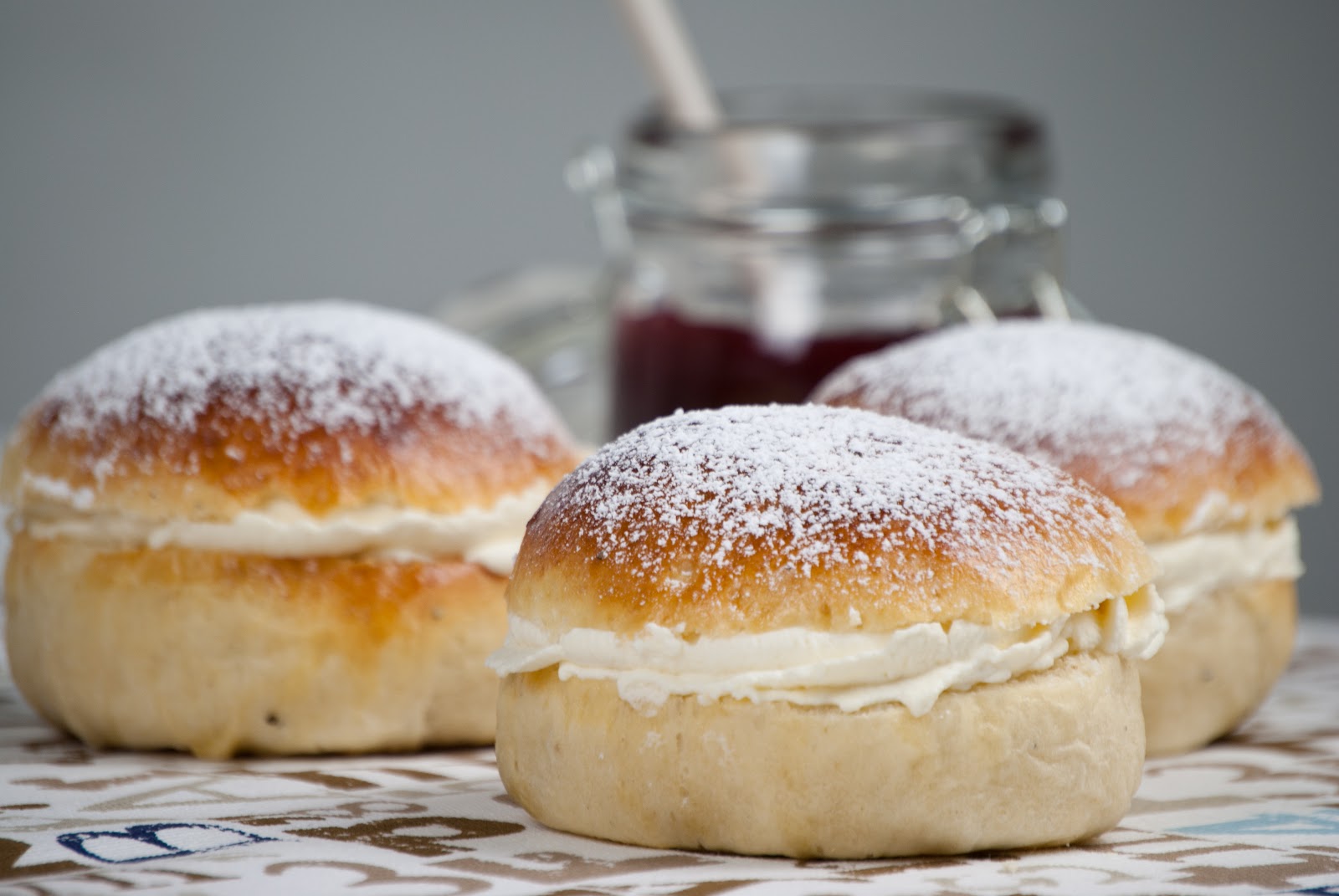
Para celebrarlo, podemos ponernos morados de laskiaispullat (bollos de Laskiainen). La laskiaispulla es un bollo de cardamomo (vaya novedad, ¿no?) que se rellena con nata y mermelada de fresa o una crema-mazapán de almendras. Aquí os dejo mi versión con mermelada casera, pero por supuesto este paso lo podéis evitar con una visita al supermercado (no hay color, pero aceptamos barco). En Finlandia existe la costumbre de congelar fresas silvestres en verano para poder usarlas en pastelería en invierno así que la receta de hoy va con fresas congeladas, pero podéis sustituirlas por fresas frescas añadiendo un poco de agua.

Al lío laskiaispulliano.


Laskiaispulla

Ingredientes (para 12 laskiaispullat):

Para los bollos:

450 – 500 grs. de harina de trigo

250 ml de leche templada

100 grs. de mantequilla en pomada

100 grs. de azúcar blanquilla

25 grs. de levadura fresca

2 huevos

1 cucharadita de cardamomo

1 pizca de sal

Azúcar glass

Para la mermelada:

500 grs. de fresas congeladas (limpias)

250 grs. de azúcar blanquilla

El zumo de medio limón

Para la nata montada:

400 ml de nata para montar

2 cucharadas de azúcar blanquilla

1 cucharadita de esencia de vainilla

Modus operandi:

*Para la mermelada casera: pon las fresas congeladas en un bol y mételas en el microondas durante 3 minutos (sáltate este paso si utilizas fresas frescas). Añade el azúcar y el zumo de limón y tritúralo todo junto (puedes dejar algunos trocitos más enteros para que la mermelada tenga otra textura). Pon la mezcla a fuego medio en una olla pequeña durante 1 hora. Deja enfriar mientras preparas los bollos.

1. Vierte la leche en un bol y añade la levadura, desmenuzándola con las manos. Agita con unas varillas hasta que la levadura se haya disuelto en la leche. Añade el azúcar, la sal, el cardamomo y un huevo. Remueve de nuevo para que se integren bien los ingredientes.

2. Añade la mitad de la harina, mezcla con ayuda de una espátula y agrega la mantequilla cortada en subitos. Mezcla bien hasta que la mantequilla se haya integrado completamente en la masa; entonces añade el resto de la harina y amasa hasta conseguir una masa suave y elástica. Coloca la masa en un bol y déjala levar tapada con un paño durante 1 hora o hasta que doble su volumen.

3. Elimina las burbujas de aire que se hayan formado en el interior con un ligero amasado. Haz 12 bolas con la masa y distribúyelas en una bandeja de horno con papel vegetal. Tápalas con un paño y déjalas levar durante 30 minutos.

4. Precalienta el horno a 200 C.

5. Bate el otro huevo y pinta con él los bollos (en este momento puedes añadir algunas almendras fileteadas). Hornea a 200 C durante 12 minutos. Deja enfriar los bollos sobre una rejilla.

6. Monta la nata con el azúcar y la esencia de vainilla ayudándote de una batidora de varillas. Coloca la nata montada en una manga pastelera.

7. Corta la parte superior de los bollos. Unta el interior con mermelada de fresa y dibuja un aro alrededor con nata montada. Cierra los bollos y decora con azúcar glass.

Hyvää ruokahalua!

*****


One more typical bun

I already told you in the post of runebergintortut that usually public holidays in Finland are somehow connected with some sweet product. Today is Laskiainen (Shrove Tuesday), a Christian celebration related to Easter, and I’m not believer but if we are talking about filling my belly with good stuff, then let’s celebrate!

These days you can eat a lot of laskiaispullat (Laskiainen buns). Laskiaispulla is a cardamom bun (what a surprise, huh?) filled with whipped cream and strawberry jam or almond marzipan cream. Here you have my version with homemade jam but of course you can skip this step with a quick visit to supermarket (it’s not the same, but good anyway). In Finland, people usually freeze fresh wild strawberries in summer, so they can use them for baking in winter. That’s why this recipe is made with frozen strawberries, but you can change them for fresh ones just adding a bit of water.

Let’s go!

Laskiaispulla

Ingredients (makes 12):

For the buns:

450 – 500 g plain flour

250 ml lukewarm milk

100 g butter, softened

100 g caster sugar

25 g fresh yeast

2 eggs

1 tsp cardamom

1 pinch of salt

Icing sugar

For the jam:

500 g clean frozen strawberries

250 g caster sugar

The juice of half a lemon

For the whipped cream:

400 ml heavy cream

2 tbsp caster sugar

1 tsp vanilla essence

Modus operandi:

*For the homemade jam: place the frozen strawberries in a bowl and heat them in the microwave for 3 minutes (skip this step if you are using fresh strawberries). Add the sugar and the lemon juice and blend everything together (you can leave some bigger pieces of fruit so the jam has a different texture). Pour the mixture into a little pot and cook at medium heat for 1 hour. Let it cool down while you bake the buns.

1. Pour the milk into a bowl and add the yeast, crumbling it with your hands. Whisk until the yeast is dissolved in the milk. Add the sugar, salt, cardamom and one egg. Whisk again so the ingredients get well mixed.

2. Add half of the flour, mix with a spatula and add the butter, diced. Mix until the butter has completely blended with the dough; then add the rest of the flour and knead to get a smooth and elastic dough. Place it in a bowl, cover with a tea towel and leave to prove for 1 hour, or until it doubles its size.

3. Knead a little bit to remove the air bubbles inside the dough. Divide the dough in 12 balls and place them on a baking tray prepared with baking paper. Cover them with a tea towel and leave to prove for 30 minutes.

4. Preheat the oven to 200 C.

5. Whisk the other egg and paint the buns with it (in this step you can also add some almond flakes). Bake at 200 C for 12 minutes. Let the buns cool down on a wire rack.

6. Whip the cream with the sugar and the vanilla essence, using an electric mixer. Place the whipped cream in a piping bag.

7. Cut the upper part of the buns. Spread some strawberry jam inside and draw a ring around with whipping cream. Close the buns and decorate with icing sugar.

Hyvää ruokahalua!

02 February 2012

Fiesta = azúcar (Runebergintortut)

(English version below)

Rara es la fiesta en Finlandia que no se asocia a un dulce. Este domingo se celebra el aniversario del nacimiento de Johan Ludvig Runeberg, el poeta finés más influyente de todos los tiempos y autor de la letra del himno nacional de Finlandia.

Para celebrarlo, hace ya un par de semanas se pueden encontrar por todas partes los runebergintortut, los dulces que supuestamente Runeberg desayunaba todas las mañanas. Se cree que la receta la inventó su mujer, Fredrika, y se hizo popular tras la publicación de su libro de recetas en la década de 1850.

Y aquí están. Por si en alguna parte del mundo alguien quiere celebrar el día de Runeberg (para darse un homenaje siempre hay una buena excusa).


Runebergintortut

Ingredientes (para 8 pastelitos):

200 grs. de mantequilla a temperatura ambiente

200 grs. de azúcar blanquilla

140 grs. de pan rallado

120 grs. de almendra molida

120 grs. de harina de trigo

2 huevos

100 ml de nata, smetana o yogur

1 cucharadita de cardamomo

1 cucharadita de levadura química

Para decorar:

Mermelada de frambuesas

100 grs. de azúcar glass

2 cucharadas de zumo de limón

Modus operandi:

1. Precalienta el horno a 200 C.

2. Mezcla la mantequilla con el azúcar con una batidora de varillas hasta que blanqueen. Añade un huevo y mezcla hasta que se integre. Repite la operación con el segundo huevo. Añade la nata (o smetana o yogur) y mezcla de nuevo.

3. Coloca en un bol la harina, el pan rallado, la almendra molida, la levadura y el cardamomo. Mezcla estos ingredientes y añádelos al bol de la mantequilla. Mezcla todos los ingredientes y vierte la masa en un molde especial para runebergintortut (en su defecto, uno para magdalenas) engrasado.

4. Hornea durante 15-20 minutos.

5. Deja reposar los pastelitos en el molde y cuando hayan templado un poco, desmóldalos y colócalos sobre una rejilla.

6. Mezcla el azúcar y el zumo de limón para preparar una glasa para decorar. Vierte la glasa en una manga pastelera desechable y corta un agujero muy pequeño (para hacer un aro como el de la foto). Dibuja un círculo de glasa sobre cada runebergintorttu (puedes darle la vuelta para que te queden más lisos) y rellénalo con mermelada de frambuesas.

*Si te parecen demasiado secos, puedes emborracharlos con un poco de licor de almendras.

Hyvää ruokahalua!

*****


Public holiday = sugar

Usually in Finland all public holidays are connected to a pie, bun or some other sweet thing. Next Sunday it’s Runeberg’s Day, when Finns celebrate the anniversary of the birth of the most influential Finnish poet, Johan Ludvig Runeberg, the writer of the national anthem.

To celebrate it, you can find these runebergintortut everywhere for some weeks, the little cakes that Runeberg used to eat for breakfast every morning, or that’s what they say. It’s believed that the recipe was an invention of his wife, Fredrika, and became popular after the publication of her recipe book, in 1850’s.

And here they are. You don’t need to find another excuse to eat something sweet. Next Sunday you can celebrate Runeberg´s Day, no matter where you are!

Runebergintortut


Ingredients (makes 8):

200 g butter, softened

200 g caster sugar

140 g breadcrumbs

120 g grinded almonds

120 g plain flour

2 eggs

100 ml cream, smetana or yogurt

1 tsp cardamom

1 tsp baking powder

For decoration:

Raspberry jam

100 g icing sugar

2 tbsp lemon juice

Modus operandi:

1. Preheat the oven to 200 C.

2. Mix together the butter and the sugar with an electric whisk until pale. Add one egg and mix well, then repeat with the second. Add the cream (or smetana or yogurt) and mix again.

3. Place in a bowl the flour, breadcrumbs, grinded almonds, baking powder and cardamom. Mix them all together and pour them over the butter mixture. Mix the ingredients and pour the batter on a greased runebergintortut mold (if you don’t have it, you can use a muffins mold instead).

4. Bake for around 15-20 minutes.

5. Let the cakes cool down for a while in the mold and then unmold and place them on a wire rack.

6. Mix the icing sugar and lemon juice until you get a white glaze for decoration. Put the glaze in a disposable piping bag and cut a very little hole (enough to make a ring like in the picture). Draw a circle with the glaze on each runebergintorttu (you can turn them upside down to get a smooth surface) and fill it with raspberry jam.

*If you think they are too dry, you can wet them with a little almond liquor.

Hyvää ruokahalua!
Related Posts Plugin for WordPress, Blogger...